---
title: XDCR Data-Type Conversion
description: XDCR filtering expressions are supported by data-type
conversion and collation.
pubDate: 2026-10-03T04:27:21.374Z
meta:
component:
title: Couchbase Server
version: "7.6"
antora:
editUrl: https://github.com/couchbase/docs-server/edit/release/7.6/modules/xdcr-reference/pages/xdcr-filtering-data-type-conversion.adoc
xref: xref:7.6@server:xdcr-reference:xdcr-filtering-data-type-conversion.adoc[]
---
[Consult the llms.txt file for a full list of contents](/llms.txt)
[View original HTML](/server/7.6/xdcr-reference/xdcr-filtering-data-type-conversion.html)
# XDCR Data-Type Conversion
> _XDCR filtering expressions_ are supported by data-type _conversion_ and _collation_.
## [](#understanding-data-type-conversion)Understanding Data-Type Conversion
_XDCR filtering expressions_ allow case-sensitive matches, comparisons, logical and other operations to be performed on values within documents. When values referenced by a filtering expression have different data types, either _conversion_ or _collation_ is performed:
* _Conversion_ means that one or both of the values is converted from its own data type to a different one, so that the operation can be performed.
* _Collation_ means that conversion is not possible; and that therefore, the operation will be resolved by value-comparison according to a set of rules.
All conversion performed by XDCR is _implicit_, meaning that it is performed automatically within the system. No _explicit_ conversion (that is, data-type conversion selected and imposed by the administrator) is supported.
## [](#supported-data-types)Supported Data Types
The data types supported by XDCR Filtering are listed below, in descending order of _precedence_ — the lowest precedence-value (and earliest position) therefore indicating the highest precedence.
| **Precedence** | **Data Type** |
| -------------- | ------------- |
| 0 | Invalid |
| 1 | Missing |
| 2 | Null |
| 3 | Boolean |
| 4 | Numeric |
| 5 | String |
| 6 | Time |
| 7 | Array |
| 8 | Object |
| 9 | Binary |
When an expression entails values of the same data type, no conversion is required. When the data types differ, and conversion or collation is therefore required, data types take precedence in accordance with their closeness to the top of the list. For example, if an operation refers to two values, one of which is _Invalid_ and the other of which is _Boolean_, the _Invalid_ value determines the result. As another example, if an operation refers to two values, one of which is _Boolean_ and the other _Numeric_, the _Numeric_ value is if possible converted to _Boolean_, and the operation performed.
The data types listed above, and their order of precedence, can be compared with those used by [SQL++](../n1ql/n1ql-language-reference/datatypes.md#collation) — which are _similar_, but not identical.
See [XDCR Filtering Expressions](xdcr-filtering-expressions.md), for information on how comparisons can be performed, using the data types listed above.
## [](#numeric-type-conversion)Numeric Data-Type Internal Conversions
A value of the _Numeric_ data type (listed above, in [Supported Data Types](#supported-data-types)) always further corresponds to one of three _internal_ numeric data types; which are _unsigned integer_, _integer_, and _float_. When two _Numeric_ data-type values are referenced in a filtering expression, comparisons (_e.g._ equality, inequality) and operations (_e.g._ addition, subtraction) are performed as indicated in the following table.
| **Type 1** | **Type 2** | **Comparison** | **Operation** |
| ---------- | ---------- | -------------------------------------------------------------------------------------------------------------------------------------------------------------------------------------------------------------------------------------------------------------- | ---------------------------------------------------------------------------------------------------------------------------------------------------------------------------------------------------------------------------------------------------------------------------------------------------------------------------------------------------------------------------- |
| Uint | Uint | The comparison is performed. | The operation is performed. If the operation results in a negative value, both values are converted to Int, and the operation is repeated; _unless_ one or both conversions to Int would result in overflow, in which case InvalidValue is returned. |
| Uint | Int | If Int is negative, Uint is converted to Int, and the comparison is performed; _unless_ the conversion to Int would result in overflow, in which case InvalidValue is returned. If Int is positive, Int is converted to Uint, and the comparison is performed. | The operation is performed. If the result is an Int, the Int is returned. If the result is a valid Uint, the Uint is returned. If the result would be _non-valid_ as a Uint (due to the result's being negative), the result is converted to Int, and is returned as such; _unless_ the conversion to Int would result in overflow, in which case, InvalidValue is returned. |
| Uint | Float | Uint is converted to Float, and the comparison is performed. | Uint is converted to Float, and the operation is performed. |
| Int | Float | Int is converted to Float, and the comparison is performed. | Int is converted to Float, and the operation is performed. |
| Float | Float | The comparison is performed. | The operation is performed. |
| Int | Int | The comparison is performed. | The operation is performed. |
## [](#implicit-conversion-vs-collation-comparison)Implicit Conversion versus Collation Comparison
_Implicit conversion_ occurs when Couchbase Server converts a value from its existing data type to another, so that a comparison or operation can be performed on values of the same data type. Implicit conversion is only _sometimes_ possible: therefore, when an existing data type _cannot_ be implicitly converted into another, _collation comparison_ is used instead.
Collation comparison works as follows:
* _Equality_ and _inequality_. Checking for _equality_ between different data types returns `false`. Therefore, if `var1` and `var2` represent different data types, the expression `var1 == var2` returns `false`.
Checking for _inequality_ between different data types returns `true`. Therefore, if `var1` and `var2` represent different data types, the expression `var1 != var2` returns `true`.
* _Regular expression_ matches. Checking for a regular-expression _match_ between different data types returns `false`. Therefore, if `var1` and `var2` represent different data types, the expression `REGEXP_CONTAINS(var1, var2)` returns `false`.
Checking for a regular-expression _non-match_ between different data types returns `true`. Therefore, if `var1` and `var2` represent different data types, the expression `NOT REGEXP_CONTAINS(var1, var2)` returns `true`.
* _Magnitude comparison_ between different data types is resolved in accordance with the respective positions of the data types in the list of [Supported Data Types](#supported-data-types)). This list presents the supported data types in order of _precedence_: note that _precedence_ and _magnitude_ are inversely proportional; and that therefore, the data type at the bottom of the list (Binary) has the least precedence and greatest magnitude; while the data type at the top (Invalid) has the greatest precedence and least magnitude.
Consequently, if the data type of `var1` is _below_ that of `var2` in the list, the expression `var1 > var2` returns `true`; and the expression `var1 < var2` returns `false`.
## [](#supported-type-conversions)Supported and Unsupported Type Conversions
The following diagram lists supported and unsupported type conversions. Conversion-support is indicated by the following:
*  Conversion can be performed.
*  Conversion can be performed under certain conditions.
*  Conversion is not required.
*  Conversion cannot be performed.
Each cell in the diagram bears one or more integers: these correspond to explanatory annotations that are listed further below.
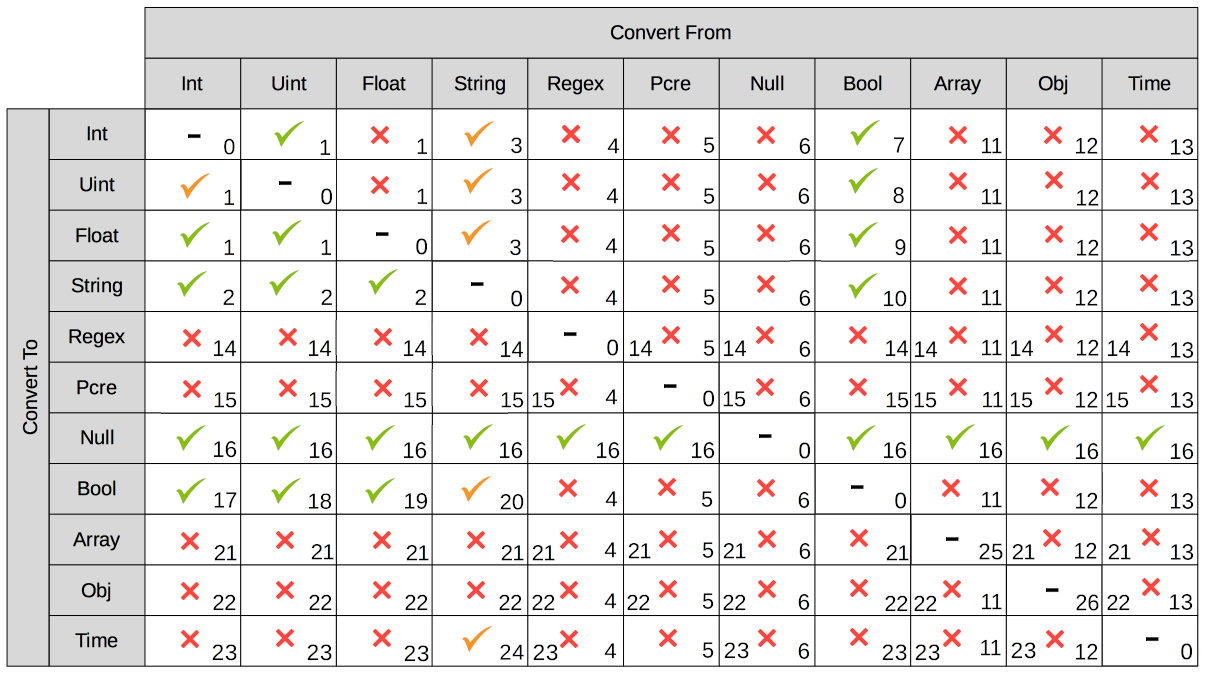
These conversion-support options are described in the following table, each row of which starts with an integer that corresponds to an annotation in the diagram above. Notes on comparison-procedures are also provided.
| # | **From** | **To** | **Validity** | **Comparison** |
| -- | ------------------------------- | ---------------------------- | --------------------------------------------------------------------------------------------------------------------------------------------------------------------------------------------------------------------------------------------------------------------------------------------- | --------------------------------------------------------------------------------------------------------- |
| 0 | | |  No conversion need be performed. | Standard comparison for the type. |
| 1 | Numeric | Numeric |    Valid, possibly valid, or invalid. See [Numeric Data-Type Internal Conversions](#numeric-type-conversion), above. | See [Numeric Data-Type Internal Conversions](#numeric-type-conversion), above, for details on comparison. |
| 2 | Numeric | String |  Valid for Int, Uint, and Float. In each case, Numeric is converted to String. | Standard string-comparison is performed. |
| 3 | String | Numeric |  Valid if String can be converted to Int; otherwise valid if String can be converted to Float; otherwise invalid. | Standard numeric-comparison is performed, if possible. Otherwise, collation comparison is performed. |
| 4 | Regex | |  Invalid. No conversion can occur, except to Null. | Collation comparison is performed, except for Regex and Null. |
| 5 | Pcre | |  Invalid. No conversion can occur, except to Null. | Collation comparison is performed, except for Pcre and Null. |
| 6 | Null | |  Invalid. No conversion can occur. | Standard comparison for the type. |
| 7 | Boolean | Int |  Valid. The Boolean values true and false are converted to the Int values 1 and 0 respectively. | Standard numeric-comparison is performed. |
| 8 | Boolean | Uint |  Valid. The Boolean values true and false are converted to the Uint values 1 and 0 respectively. | Standard numeric-comparison is performed. |
| 9 | Boolean | Float |  Valid. The Boolean values true and false are converted to the Float values 1.0 and 0.0 respectively. | Standard numeric-comparison is performed. |
| 10 | Boolean | String |  Valid. A Boolean can be converted to a String whose value is either "true" or "false" | The string-comparison "true" > "false" returns true. |
| 11 | Array | |  Invalid. | Collation comparison is performed for all except Array and Null. |
| 12 | Object | |  Invalid. | Collation comparison is performed for all except Object and Null. |
| 13 | Time | |  Invalid. | Collation comparison is performed for all except Time and Null. |
| 14 | | Regex |  Invalid. | Collation comparison is performed for all except Regex. |
| 15 | | Pcre |  Invalid. | Collation comparison is performed for all except Pcre. |
| 16 | | Null |  Valid. is converted a non-Null value, for comparison with Null. | The comparison non-Null > Null returns true. |
| 17 | Int | Boolean |  Valid for all Int values. The Int value 0 is converted to the Boolean value false; all other Int values are converted to the Boolean value true. | The boolean-comparison true > false returns true. |
| 18 | Uint | Boolean |  Valid for all Uint values. The Uint value 0 is converted to the Boolean value false; all other Uint values are converted to the Boolean value true. | The boolean-comparison true > false returns true. |
| 19 | Float | Boolean |  Valid for all Float values. The Float value 0.0 is converted to the Boolean value false; all other Float values are converted to the Boolean value true. | The boolean-comparison true > false returns true. |
| 20 | String | Boolean |  Valid if String is case-insensitive "true" or "false"; in which case String is converted to its Boolean equivalent. | The boolean-comparison true > false returns true. |
| 21 | | Array |  Invalid. | Collation comparison is performed. |
| 22 | | Object |  Invalid. | Collation comparison is performed. |
| 23 | arg_2`, this gets applied as `Array_1 > Array_2`; and if the length of `Array_1` is indeed greater than the length of `Array_2`, the condition is considered to have been met; whereby `true` is returned, and the comparison-process ends.
In cases where the condition specified by the expression is one of inequality (_i.e._, `>`, `<`, `!=`), the array-lengths are _not_ equal, and the specified condition is _not_ met (for example, where the expression is `arg_1 > arg_2`, and the length of `Array_1` is less than that of `Array_2`), `false` is returned, and the comparison-process ends.
In cases where the condition specified by the expression is one of inequality, and the condition is not met due to the array-lengths being _equal_, the comparison-process continues as follows: in sequence, pairs of correspondingly positioned objects from the arrays are compared, until the specified requirement is met, or is finally determined _not_ to have been met. For example, if the expression is `arg_1 > arg_2`, this gets applied as `Array_1[0] > Array_2[0]`, `Array_1[1] > Array_2[1]`, and so forth.
### [](#note-for-row-26)Note for Row 26
Comparison is performed along the following lines: the specified expression is first applied to the objects in terms of their respective lengths. For example, if the expression is `arg_1 > arg_2`, this gets applied as `Object_1 > Object_2`; and if the length of `Object_1` is indeed greater than the length of `Object_2`, the requirement is considered to have been met; whereby `true` is returned, and the comparison-process ends.
In cases where the condition specified by the expression is one of inequality (_i.e._, `>`, `<`, `!=`), the object-lengths are _not_ equal, and the specified condition is _not_ met (for example, where the expression is `arg_1 > arg_2`, and the length of `Object_1` is less than that of `Object_2`), `false` is returned, and the comparison-process ends.
In cases where the condition specified by the expression is one of inequality, and the condition is not met due to the object-lengths being _equal_, the comparison-process continues as follows: in sequence, pairs of correspondingly positioned data-bytes from the objects are compared, until the specified requirement is met, or is finally determined _not_ to have been met. For example, if the expression is `arg_1 > arg_2`, this gets applied as `Object_1[0] > Object_2[0]`, `Object_1[1] > Object_2[1]`, and so forth.
## [](#implicit-conversion-modes)Implicit Conversion Modes
Each filter expression requires implicit conversion to be applied to one of the following combinations:
* _A Constant and a Variable_. The filter expression contains a user-specified constant and a variable, which are to be compared. Couchbase Server determines the data type of the constant, and attempts to apply this data type to the value of the variable.
* _Two Variables_. The filter expression specifies two variables, which are to be compared. Couchbase Server determines the data type of the variables from the corresponding values in the JSON document to which filtering is currently being applied.
These modes are described in the subsections below.
### [](#implicit-conversion-of-constant-and-variable)Implicit Conversion of Constant and Variable.
When a constant and a variable are to be compared, Couchbase Server determines the data type of the constant, and attempts to apply this also to the value of the variable.
#### [](#data-type-conversion-of-user-specified-constants)Data-Type Conversion of User-Specified Constants
When the user explicitly enters a _constant_ into a filter expression, the data type for the constant is evaluated by Couchbase Server, as part of its process for _tokenizing_ the expression (that is, parsing the expression into identifiable lexical components).
The correspondences between token formats and duly assigned data types is described in the following table.
| **Token Format** | **Assigned Data Type** | **Example** |
| ---------------------------------------------------------------------------------------------------------------------------- | ---------------------- | --------------------------------------------------- |
| Any character-sequence enclosed either by double quotes ("") or by single quotes (''). | String | variable == "a string" Variable == 'another string' |
| Any numeric values without precision delimiter or mantissa. | Int | variable > 1234 variable < -2345 |
| Any number representing a valid golang float, optionally with precision delimiter and/or mantissa. | Float | variable >= 1.2343e+25 |
| Any of the following, specified without enclosing punctuation (such as commas or inverted commas): true, TRUE, false, FALSE. | Boolean | variable == true variable != FALSE |
| Either of the keyword-phrases IS NULL and IS NOT NULL. | null | variable IS NULL variable IS NOT NULL |
| Valid hard-coded strings wrapped by the DATE() function. | date | variable < DATE("2018-10-17T00:01:02Z") |
##### [](#mathematical-data-types)Mathematical Data Types
_Mathematical expressions_ may be entered as constants.
**Division**
When an expression includes a _division_ operation, the result of which is intended to be a decimal number, the operands themselves must be specified as (or, if they are variables, allowed to be implicitly cast to) decimals.
For example, if `A == 4` returns `true`, then `1 / A == 0.25` returns `false`; because the expression `1 / A` casts `A` implicitly to `Int`, and duly returns an `Int`. Thus, `Int(1 / 4) == 0` returns `true`.
On the other hand, `1.0 / A == 0.25` returns `true`; because the expression `1.0 / A` casts `A` implicitly to `Float`, and duly returns a `Float`. Thus, `1.0 / 4.0 == 0.25` returns `true`.
**Not-a-Number Values**
`NaN` (_Not-a-Number_) float-values are considered _less_ than any other real number.
Two `NaNs` do _not_ yield equality. Note, however, that the operators `<=` and `=>` return `true`: this differs from the `golang` standard (according to which these operators return `false`).
#### [](#data-type-conversion-of-variable-values)Data-Type Conversion of Variable-Values, for Comparison with Constants
When an expression includes both a constant and a variable, [Implicit Conversion to Constant Data-Type](#implicit-conversion-to-constant-data-type) is performed on the constant. Then, the data-type derived from evaluation of the constant is assigned, attemptedly, to the value represented by the variable.
For example, given the expression `variable > 4.5`, the constant `4.5` is determined to be a `Float`. The value of `variable` is then examined; and if determined not itself to be a `Float`, is attemptedly converted to `Float`.
If conversion of the variable's value into the data type specified by the user is not possible, collation comparison is performed. For example, given the expression `variable != true`, if the value of `variable` is not `Boolean`, collation comparison is performed, and `true` is returned, due to the data types' being different.
If the data-type of the user-specified constant is `Numeric`, and the value of the variable is also `Numeric`, the appropriate numeric data-type internal conversion is performed (see [above](#numeric-type-conversion)).
If the value is `NaN`, the value is converted to the `Invalid` data-type, and collation comparison is performed. For example, given the expression `ASIN(variable) > 0`, if the value of `variable` is `93`, then `ASIN(93)`results in a `NaN` value, which is then duly converted to `Invalid`. Collation comparison is then performed, and returns that the `NaN` is smaller than the `Int`.
Alternatively, given the expression `ASIN(variable) != 0`, collation comparison returns `true`, due to the comparison's being made between different data types (`Invalid` and `Int`).
An explanation of comparisons with `NaN` values is provided in [Not-a-Number Values](#not-a-number-values), above.
### [](#implicit-conversion-between-variables)Implicit Conversion between Variables
When an expression consists entirely of variables (for example, `variable != otherVariable`), Couchbase Server retrieves the corresponding values from the JSON document to which filtering is currently being applied, and performs conversions on the values.
The result of conversion may vary for each variable, document by document, based on changes encountered in JSON definitions.
Couchbase Server performs conversion differently, according to whether both values are determined to be `Numeric`.
#### [](#numeric-comparison)Numeric Comparison
If the values of both variables are determined to be `Numeric`, the appropriate numerical comparison from those described in [Data Type Conversion of User-Specified Constants](#data-type-conversion-of-user-specified-constants) is made.
#### [](#non-numeric-comparison)Non-Numeric Comparison
If the values for the variables are not both numeric, both require non-numeric conversion. Conversion is performed based on the following sequence:
1. Whether the perceived types support comparison. See the diagram in [Supported and Unsupported Type Conversions](#supported-type-conversions) for information.
2. Whether, if the perceived types _do_ support comparison, a successful attempt can be made to convert the less restrictive data type to the more restricted. See the table in [Supported Data Types](#supported-data-types), for information.
3. Whether, if the less restrictive data type _cannot_ be converted to the more restricted, the more restricted can be converted to the less.
If conversion cannot be achieved by the above sequence, collation comparison is performed.
For example, given the expression `variable1 > variable2`, where `variable1` is the `Boolean` value `true`, and `variable2` is the `String` value `"test"`:
1. The perceived types are checked as to whether they support direct comparison. They do not.
2. The `String` value `test` is attemptedly cast to a `Boolean`: which fails.
3. The `Boolean` value `true` is attemptedly cast to a `String`: which succeeds — the new `String` value being `"true"`.
A comparison between the strings is now performed, with the result being `true`.
Alternatively, given the same expression, where `variable1` is now the `String` value `"test"`, and `variable2` is a JSON array; conversion cannot be achieved by the sequence. Therefore, collation comparison is performed; the result of which is `false`, because `Array` is of lower precedence (and therefore, higher magnitude) than `String` — see [Supported Data Types](#supported-data-types) for the precedence-list of data types.