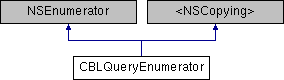
Enumerator on a CBLQuery's result rows.
The objects returned are instances of CBLQueryRow.
|
| NSUInteger | count |
| | The number of rows returned in this enumerator. More...
|
| |
| UInt64 | sequenceNumber |
| | The database's current sequenceNumber at the time the view was generated. More...
|
| |
| BOOL | stale |
| | YES if the database has changed since the view was generated. More...
|
| |
◆ nextObject()
◆ nextRow()
The next result row.
This is the same as -nextObject but with a checked return type.
◆ rowAtIndex:()
Random access to a row in the result.
◆ sortUsingDescriptors:()
| - (void) sortUsingDescriptors: |
|
(NSArray *) |
sortDescriptors |
|
Re-sorts the rows based on the given sort descriptors.
This operation requires that all rows be loaded into memory, so you can't have previously called -nextObject, -nextRow or for...in on this enumerator. (But it's fine to use them after calling this method.) You can call this method multiple times with different sort descriptors, but the effects on any in-progress enumeration are undefined. The items in the array can be NSSortDescriptors or simply NSStrings. An NSString will be treated as an NSSortDescriptor with the string as the keyPath; prefix with a "-" for descending sort. Key-paths are interpreted relative to a CBLQueryRow, so they should start with "value" to refer to the value, or "key" to refer to the key. A limited form of array indexing is supported, so you can refer to "key[1]" or "value[0]" if the key or value are arrays. This only works with indexes from 0 to 3.
◆ NS_UNAVAILABLE()
| - (instancetype) NS_UNAVAILABLE |
|
|
|
◆ reset()
◆ count
The number of rows returned in this enumerator.
◆ sequenceNumber
| - (UInt64) sequenceNumber |
|
readatomicassign |
The database's current sequenceNumber at the time the view was generated.
◆ stale
YES if the database has changed since the view was generated.
The documentation for this class was generated from the following file:

 1.8.14