Loading...
Searching...
No Matches
disjunction_query Class Reference
The disjunction query is a compound query. More...
#include <couchbase/disjunction_query.hxx>
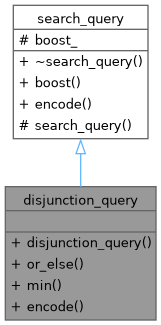
Inheritance diagram for disjunction_query:
Public Member Functions | |
| template<typename... SearchQuery> | |
| disjunction_query (SearchQuery &&... queries) | |
| Create a disjunction query. | |
| template<typename... SearchQuery> | |
| auto | or_else (SearchQuery... queries) -> disjunction_query & |
| Add one or more queries to add to the disjunction. | |
| auto | min (std::uint32_t number_of_queries) -> disjunction_query & |
| Set the minimum number of child queries that must be satisfied for the disjunction query. | |
| auto | encode () const -> encoded_search_query override |
| Public Member Functions inherited from search_query | |
| virtual | ~search_query ()=default |
| template<typename derived_query = search_query, std::enable_if_t< std::is_base_of_v< search_query, derived_query >, bool > = true> | |
| auto | boost (double boost) -> derived_query & |
| The boost parameter is used to increase the relative weight of a clause (with a boost greater than 1) or decrease the relative weight (with a boost between 0 and 1). | |
Additional Inherited Members | |
| Protected Member Functions inherited from search_query | |
| search_query ()=default | |
| Protected Attributes inherited from search_query | |
| std::optional< double > | boost_ {} |
Detailed Description
The disjunction query is a compound query.
The result documents must satisfy a configurable minimal (min) number of child queries. By default this min is set to 1.
At execution, a conjunction query that has no child queries is not allowed and will fail fast.
Match documents with at least one (see min) of the following conditions is satisfied:
- "location" in the field reviews.content
- true in the field free_breakfast.
auto query =
couchbase::disjunction_query{
couchbase::match_query("location hostel").field("reviews.content"),
couchbase::boolean_field_query(true).field("free_breakfast"),
couchbase::boolean_field_query(true).field("late_check_in"),
}
.min(2);
- See also
- https://docs.couchbase.com/server/current/fts/fts-supported-queries-conjuncts-disjuncts.html server documentation
- Since
- 1.0.0
- Committed
- Generally available API and should be preferred in production
Constructor & Destructor Documentation
◆ disjunction_query()
template<typename... SearchQuery>
|
inlineexplicit |
Create a disjunction query.
- Template Parameters
-
SearchQuery any subclass of search_query
- Parameters
-
queries sequence of query arguments
- Since
- 1.0.0
- Committed
- Generally available API and should be preferred in production
Member Function Documentation
◆ encode()
|
nodiscardoverridevirtual |
- Returns
- encoded representation of the query.
- Since
- 1.0.0
- Internal
- Internal interface
Implements search_query.
◆ min()
|
inline |
Set the minimum number of child queries that must be satisfied for the disjunction query.
- Parameters
-
number_of_queries minimum number of child queries.
- Returns
- this query for chaining purposes.
- Since
- 1.0.0
- Committed
- Generally available API and should be preferred in production
◆ or_else()
template<typename... SearchQuery>
|
inline |
Add one or more queries to add to the disjunction.
- Template Parameters
-
SearchQuery any subclass of search_query
- Parameters
-
queries sequence of query arguments
- Returns
- this query for chaining purposes.
- Since
- 1.0.0
- Committed
- Generally available API and should be preferred in production
The documentation for this class was generated from the following file:
- couchbase/disjunction_query.hxx