Loading...
Searching...
No Matches
numeric_range_query Class Reference
The numeric range query finds documents containing a numeric value in the specified field within the specified range. More...
#include <couchbase/numeric_range_query.hxx>
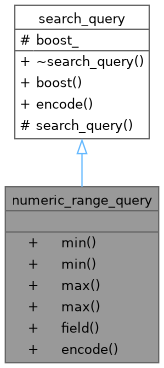
Inheritance diagram for numeric_range_query:
Public Member Functions | |
| auto | min (double value) -> numeric_range_query & |
| Set lower limit of the range. | |
| auto | min (double value, bool inclusive) -> numeric_range_query & |
| Set lower limit and specify whether to include it into the limit. | |
| auto | max (double value) -> numeric_range_query & |
| Set upper limit of the range. | |
| auto | max (double value, bool inclusive) -> numeric_range_query & |
| Set upper limit and specify whether to include it into the limit. | |
| auto | field (std::string field_name) -> numeric_range_query & |
| If a field is specified, only terms in that field will be matched. | |
| auto | encode () const -> encoded_search_query override |
| Public Member Functions inherited from search_query | |
| virtual | ~search_query ()=default |
| template<typename derived_query = search_query, std::enable_if_t< std::is_base_of_v< search_query, derived_query >, bool > = true> | |
| auto | boost (double boost) -> derived_query & |
| The boost parameter is used to increase the relative weight of a clause (with a boost greater than 1) or decrease the relative weight (with a boost between 0 and 1). | |
Additional Inherited Members | |
| Protected Member Functions inherited from search_query | |
| search_query ()=default | |
| Protected Attributes inherited from search_query | |
| std::optional< double > | boost_ {} |
Detailed Description
The numeric range query finds documents containing a numeric value in the specified field within the specified range.
Either min or max can be omitted, but not both.
By default, min is inclusive and max is exclusive.
Match documents where field id contains numbers in the range (100, 1000):
auto query = couchbase::numeric_range_query()
.field("id")
.min(100, /* inclusive= */ false)
.max(1000, /* inclusive= */ false);
- Since
- 1.0.0
- Committed
- Generally available API and should be preferred in production
Member Function Documentation
◆ encode()
|
nodiscardoverridevirtual |
- Returns
- encoded representation of the query.
- Since
- 1.0.0
- Internal
- Internal interface
Implements search_query.
◆ field()
|
inline |
If a field is specified, only terms in that field will be matched.
- Parameters
-
field_name name of the field to be matched
- Returns
- this query for chaining purposes.
- Since
- 1.0.0
- Committed
- Generally available API and should be preferred in production
◆ max() [1/2]
|
inline |
Set upper limit of the range.
Whether to include limit into the range will be decided by server defaults (exclusive).
- Parameters
-
value upper limit of the range
- Returns
- this query for chaining purposes.
- Since
- 1.0.0
- Committed
- Generally available API and should be preferred in production
◆ max() [2/2]
|
inline |
Set upper limit and specify whether to include it into the limit.
- Parameters
-
value upper limit of the range. inclusive whether to include limit value into the interval.
- Returns
- this query for chaining purposes.
- Since
- 1.0.0
- Committed
- Generally available API and should be preferred in production
◆ min() [1/2]
|
inline |
Set lower limit of the range.
Whether to include limit into the range will be decided by server defaults (inclusive).
- Parameters
-
value lower limit of the range.
- Returns
- this query for chaining purposes.
- Since
- 1.0.0
- Committed
- Generally available API and should be preferred in production
◆ min() [2/2]
|
inline |
Set lower limit and specify whether to include it into the limit.
- Parameters
-
value lower limit of the range. inclusive whether to include limit value into the interval.
- Returns
- this query for chaining purposes.
- Since
- 1.0.0
- Committed
- Generally available API and should be preferred in production
The documentation for this class was generated from the following file:
- couchbase/numeric_range_query.hxx